
For a reason, carrot cake and pineapple are a classic combo. The pineapple brings acidity that reacts with the baking soda to give it lift and keep the crumb tender. It also gives moisture for days. This Hawaiian Carrot Pineapple Cake features coconut and toasted macadamia nuts for an island spin on the American classic. It’s flavored with cinnamon, ginger and nutmeg, baked in a 9×13 inch pan, and finished with cream cheese frosting.
Water is the biggest variable in any carrot pineapple cake. Since canned pineapple is very juicy, the recipe assumes you drain the fruit well. Here’s how to prevent a cake from being too gummy, and other techniques that separate a moist cake from a gummy one.
Why This Cake Works
Butter substitute oil: Oil is 100 % fat; butter is about 80 % fat with some water and milk solids. The oil coats the flour proteins, preventing gluten formation. It stays liquid at room temperature. This gives you a soft crumb that doesn’t harden as the cake cools down or sits in the fridge.
Two sugars. Granulated sugar provides structure and a little bit of crispness. Light brown sugar holds moisture and adds a mild molasses flavor that pairs nicely with the spices and pineapple.
Baking soda + acid. The pineapple and brown sugar are a little tangy. The moment it’s mixed in, the baking soda reacts with that acid, and again in the heat of the oven, so a small amount of baking powder backs it up for a reliable rise.
Not dumped pineapple, drained pineapple. The pineapple should add flavor and sweetness. Juice that wasn’t drained would waterlog the batter and create a dense, damp layer in the bottom of the cake.
Ingredients
For the cake (one 9×13-inch cake, about 15 slices)
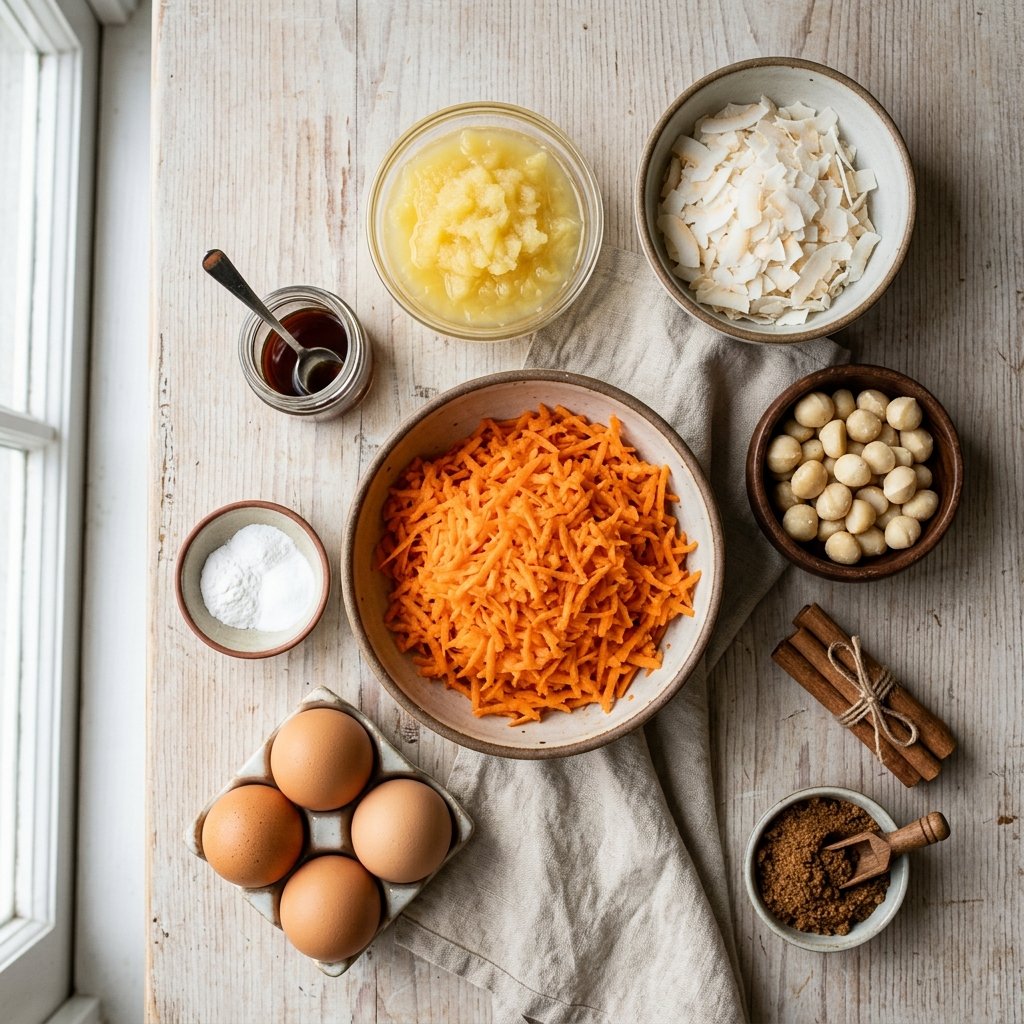
- 2 cups (250 g) all-purpose flour
- 1 teaspoon baking soda
- 1 teaspoon baking powder
- 1 teaspoon fine salt
- 2 teaspoons ground cinnamon
- ½ teaspoon ground ginger
- ¼ teaspoon ground nutmeg
- 1 cup (200 g) granulated sugar
- ½ cup (100 g) light brown sugar, packed
- 3 large eggs, at room temperature
- ⅔ cup (160 ml) neutral oil (canola, sunflower, or avocado)
- 1 teaspoon pure vanilla extract
- 2 cups (about 220 g) finely grated carrots (about 4 medium carrots)
- 1 cup (about 225 g) canned crushed pineapple in juice, thoroughly drained (from one 20-oz / 567 g can)
- ¾ cup (60 g) sweetened shredded coconut
- ¾ cup (90 g) macadamia nuts, chopped and toasted
For the cream cheese frosting
- 8 oz (226 g) full-fat block cream cheese, cool but not cold
- ½ cup (113 g) unsalted butter, softened
- 2½ cups (300 g) powdered sugar, sifted
- 1 teaspoon vanilla extract
- Pinch of salt
To finish
- 2 to 3 tablespoons reserved pineapple juice (optional, for brushing)
- ¼ cup toasted shredded coconut and a handful of chopped macadamias, for the top
Ingredient Notes and Substitutions
| Ingredient | Role | Substitution and effect |
|---|---|---|
| Macadamia nuts | Buttery richness, gentle crunch | Walnuts or pecans work. The flavor is earthier and slightly more bitter. Toast them the same way. |
| Sweetened shredded coconut | Chew and tropical flavor | Unsweetened works, but the cake will be a little less sweet. Skip it entirely if you dislike coconut, and add 2 tablespoons more flour-free moisture by leaving the pineapple slightly less drained. |
| Canned crushed pineapple | Acid, sweetness, moisture | Fresh pineapple can work if you cook it first (see below). Pineapple tidbits should be chopped fine. |
| Neutral oil | Tenderness, moisture | Melted coconut oil (refined, for mild flavor) works. Olive oil adds a noticeable flavor. Butter is not a 1:1 swap because of its water content. |
| All-purpose flour | Structure | Cake flour gives a slightly softer crumb but a less sturdy cake for this heavy, chunky batter. |
Fresh Pineapple: Fresh pineapple contains an enzyme called bromelain, which breaks down proteins. This can weaken the structure in a batter with eggs and flour. Canned pineapple has already been heat-treated and the enzyme inactivated. If fresh, dice it finely, simmer for a few minutes first and then drain well.
As for the carrots: Grate them using the small holes of a box grater or the fine-grating disk of a food processor. The fine shreds soften completely during baking and disappear into the crumb. Thick shreds remain stringy.
Equipment
- 9×13-inch (23×33 cm) baking pan, greased and lined with parchment
- Fine-mesh sieve for draining the pineapple
- Two mixing bowls
- Rubber spatula
- Electric mixer for the frosting (a hand mixer is fine)
- Wire rack. Cooling the cake fully before frosting is not optional (see the notes in the instructions).
Instructions
Prep
- Heat the oven to 350°F (175°C). Set the rack in the middle. Grease the pan and line it with parchment, leaving an overhang so you can lift the cake out later.
- Toast the macadamias. Spread the chopped nuts on a sheet pan and toast for 6 to 8 minutes, until fragrant and lightly golden at the edges. Macadamias have a high oil content and go from golden to bitter quickly, so check early. Cool them completely. Toasting deepens their flavor and keeps them crisp inside the moist cake.
- Drain the pineapple. Tip the crushed pineapple into a fine-mesh sieve set over a bowl. Press firmly with the back of a spatula for a full minute, until it stops dripping. You should have about 1 cup of drained fruit. Save the juice.
Make the batter
- Whisk the dry ingredients. In one bowl, whisk the flour, baking soda, baking powder, salt, cinnamon, ginger, and nutmeg. Whisking distributes the leaveners and spices evenly, so you don’t bite into a bitter pocket of baking soda.
- Whisk the wet ingredients. In a large bowl, whisk both sugars with the eggs, oil, and vanilla for about 1 to 2 minutes, until the mixture looks glossy and slightly thickened. The brown sugar should no longer be visible as lumps. This step dissolves the sugar and emulsifies the oil into the eggs, which gives an even, fine crumb.
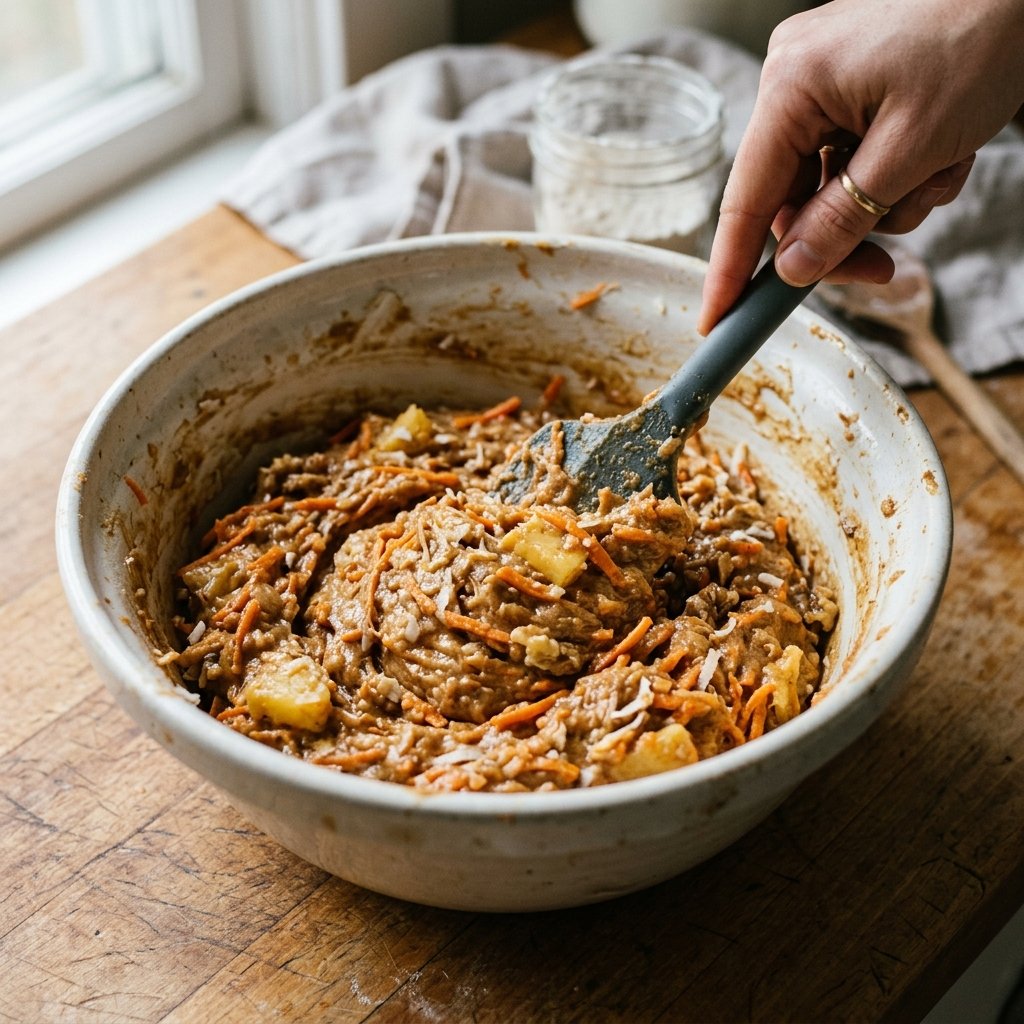
- Fold in the add-ins. Stir in the carrots, drained pineapple, coconut, and cooled macadamias. The mixture will look very chunky and loose at this stage, which is normal.
- Add the dry ingredients. Fold them in with a spatula, turning the bowl and scraping the bottom, until you can no longer see dry flour. Stop there. Extra mixing develops gluten and gives a chewy, tough cake instead of a soft one.
Bake
- Fill the pan. Scrape the batter into the pan and spread it evenly into the corners. Tap the pan on the counter once or twice to release large air bubbles.
- Bake for 35 to 40 minutes. The cake is done when the top is deep golden, the edges pull slightly from the pan, the center springs back when lightly pressed, and a toothpick inserted into the middle comes out with a few moist crumbs (not wet batter). If you use a thermometer, the center should read around 205°F (96°C). Because this batter is dense and wet, check for doneness in the center, not near the edge.
- Brush and cool. While the cake is still warm, brush the top with 2 to 3 tablespoons of the reserved pineapple juice if you like a little extra moisture and a brighter flavor. Cool the cake in the pan on a wire rack for about 15 minutes, then lift it out with the parchment and cool completely, roughly 1 to 1½ hours.
Frost
- Beat the base. With a mixer, beat the cream cheese and butter on medium speed for 1 to 2 minutes until smooth with no lumps. Use block cream cheese, not the spreadable tub kind, which has more water and produces a runny frosting.
- Add sugar. Reduce the speed to low and add the powdered sugar in two or three additions. Add the vanilla and salt, then beat on medium for about 1 minute until fluffy. Don’t overbeat, since cream cheese frosting loosens if worked too long.
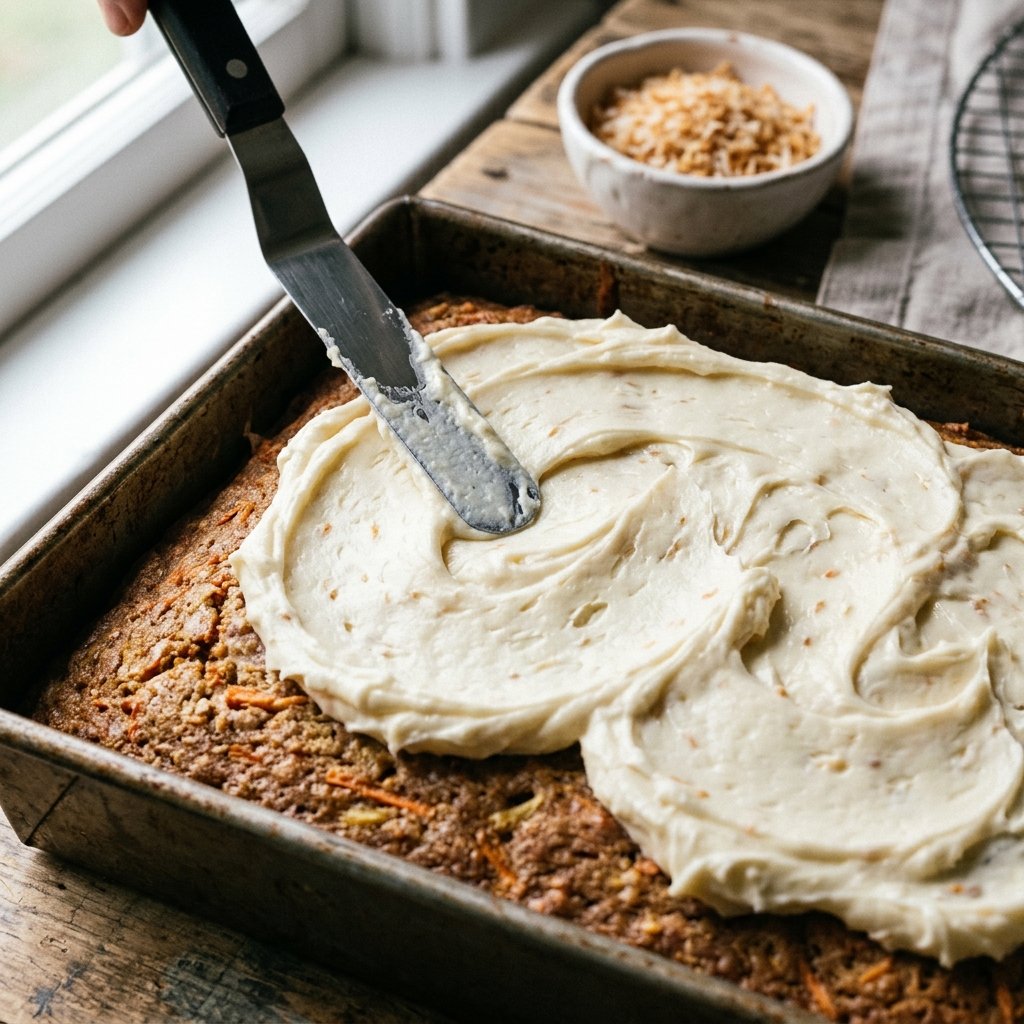
- Spread and top. Spread the frosting over the fully cooled cake. Frosting a warm cake causes the fat to melt and slide off. Scatter the toasted coconut and macadamias on top. To toast the coconut, spread it on a sheet pan and bake at 350°F for 3 to 5 minutes, stirring once or twice, until pale gold.
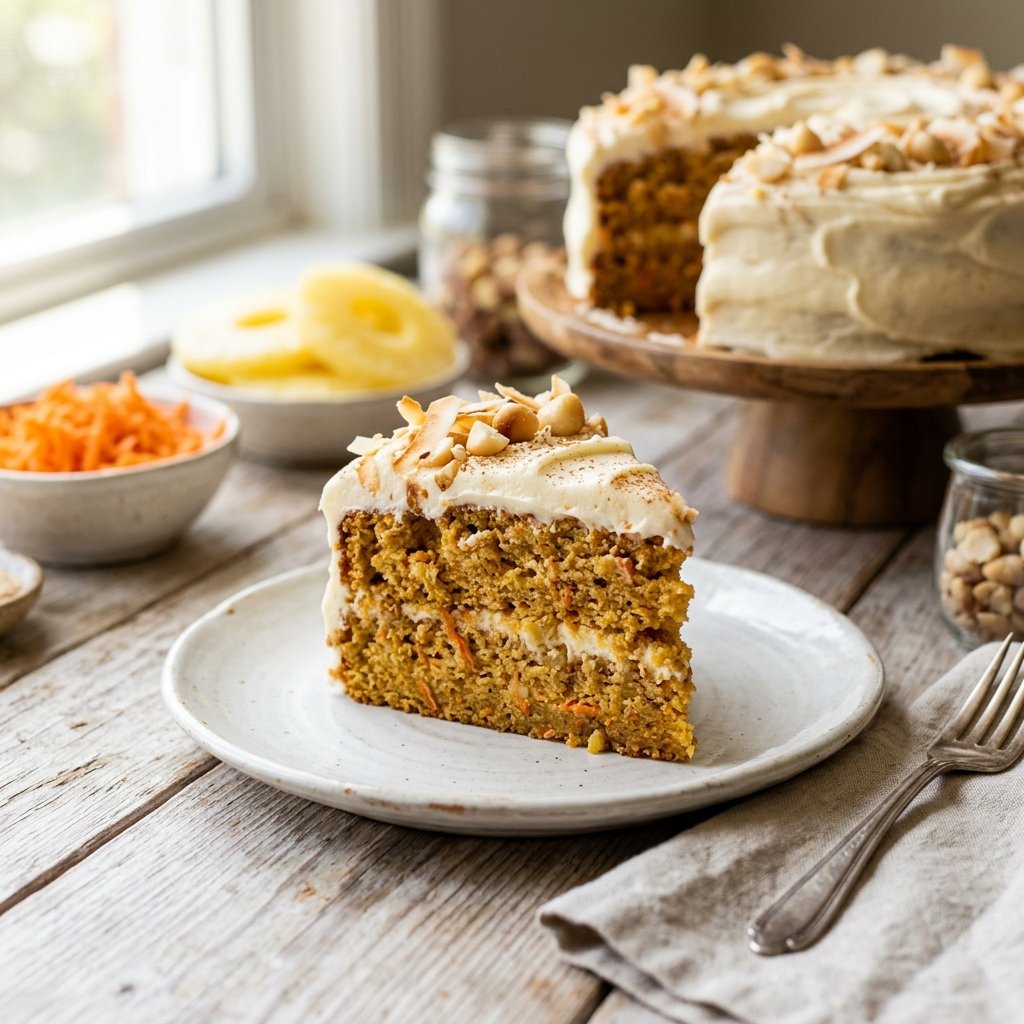
Show Image
Image subject: a single slice on a plate, cut cleanly to show the moist, flecked crumb.
Filename: slice-hawaiian-carrot-pineapple-cake-moist-crumb.jpg
Alt text: “A slice of Hawaiian carrot pineapple cake showing a moist orange-flecked crumb and thick frosting”
Troubleshooting
| Problem | Likely cause | Fix |
|---|---|---|
| Dense, wet layer at the bottom | Pineapple wasn’t drained well enough | Press the fruit in a sieve until it stops dripping, and measure after draining. |
| Dry or crumbly cake | Overbaked, or too much flour from scooping | Spoon and level flour or weigh it. Check the cake at 35 minutes. |
| Tough, chewy texture | Batter overmixed after adding flour | Fold only until no flour streaks remain. |
| Sunken center | Underbaked, or oven door opened early | Confirm doneness in the center. Avoid opening the oven before the last 10 minutes. |
| Runny frosting | Tub cream cheese, warm ingredients, or a warm cake | Use block cream cheese. Chill the frosting for 20 minutes if it’s soft. |
| Nuts taste bitter | Macadamias over-toasted | Toast at a lower time and pull them when just golden. |
Variations
- Layer cake: Divide the batter between two 9-inch (23 cm) round pans and bake for about 28 to 33 minutes. Double the frosting for filling and coating.
- Cupcakes: Fill liners about two-thirds full and bake for roughly 18 to 22 minutes.
- Nut-free: Leave out the macadamias, or replace them with toasted sunflower seeds. Check labels on your coconut and other ingredients as well.
- Less sweet frosting: Reduce the powdered sugar to 2 cups (240 g) and add a squeeze of lime juice for balance.
- Extra spice: Add ¼ teaspoon ground cardamom to the dry ingredients.
Serving, Storing, and Freezing
Serving: Slice into squares once the frosting has set slightly. Chilling the cake for 30 minutes makes for cleaner cuts, and letting slices sit out for about 15 minutes before serving brings back the soft, tender crumb. It goes well with coffee, black tea, or a scoop of vanilla or coconut ice cream.
Storing: Because of the cream cheese frosting, store the cake covered in the refrigerator. Food-safety guidance for perishable foods is to avoid leaving them out at room temperature for more than 2 hours, and leftovers are generally best eaten within 3 to 4 days.
Freezing: Unfrosted cake freezes well. Cool it completely, wrap it tightly in plastic wrap and foil, and freeze for up to a couple of months for best quality. Thaw overnight in the refrigerator, then frost. Frosted slices can also be frozen individually, though the frosting texture may soften slightly after thawing.
Make ahead: Bake the cake a day ahead, wrap it, and frost on the day you serve it. The flavor of the spices and pineapple often tastes more rounded after a night of resting.
FAQ
How do you keep a carrot pineapple cake moist?
To keep a carrot pineapple cake moist, use oil for tenderness, brown sugar to lock in moisture, and well-drained pineapple to offset the moisture. Check with a toothpick for a few moist crumbs to prevent overbaking, and cover the cake to keep it from drying out.
Do you have to drain the pineapple for carrot cake?
Crushed pineapple: Yes, you should drain it for carrot cake. Extra juice will make the batter too wet and can cause a dense, gummy bottom layer. Press the fruit through a sieve, until it stops dripping and reserve the juice for use separately e.g. to brush on the warm cake.
Can you use fresh pineapple in a Hawaiian carrot cake?
Yes, you can use fresh pineapple, but cook it briefly first. Fresh pineapple contains bromelain, an enzyme that can weaken the cake’s structure, and simmering the diced fruit for a few minutes deactivates it. Drain it well afterward, just like canned.
Can you make Hawaiian carrot pineapple cake ahead of time?
Yes, this cake can be made a day ahead. Bake and cool it completely, wrap it well, and frost it before serving. It can also be frozen unfrosted for longer storage.
Does carrot cake need to be refrigerated?
The carrot cake has a cream cheese frosting, which contains dairy, so the cake needs to be refrigerated. An unfrosted cake can be covered and left at room temperature for a short time, but frosted cake is best kept cold and allowed to come slightly to room temperature before serving.
Can I use walnuts instead of macadamia nuts?
Yes, walnuts or pecans can replace macadamia nuts in equal amounts. The flavor will be earthier and a bit more assertive, but the texture is similar. Toast them first for the best flavor.
What is the difference between carrot cake and Hawaiian carrot cake?
Hawaiian carrot cake is a twist on carrot cake and includes crushed pineapple, coconut and sometimes macadamia nuts. They give a tropical flavor and add more moisture than a standard carrot cake would, which normally has carrots, spices and sometimes walnuts or raisins.
Final Thoughts
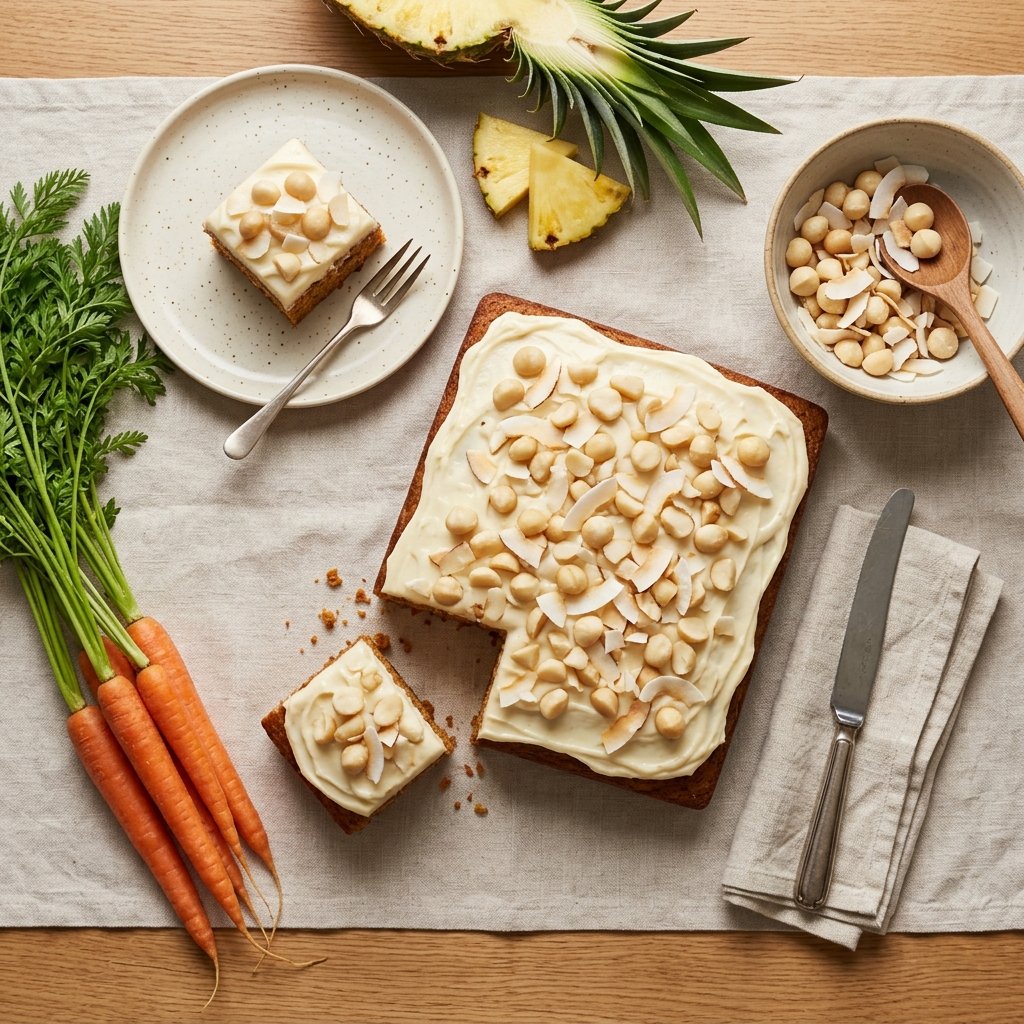
This Hawaiian carrot pineapple cake brings the familiar warmth of carrot cake with a brighter, more tropical character. The most important details are draining the pineapple well, toasting the nuts and letting the cake cool completely before frosting. If you make it the day before, the flavors will blend, and it will be easier to slice cleanly.
Hawaiian Carrot Pineapple Cake with Cream Cheese Frosting
Ingredients
Equipment
Method
- Heat the oven to 350°F (175°C). Grease the pan and line it with parchment, leaving an overhang.
- Spread the chopped macadamias on a sheet pan and toast for 6 to 8 minutes until fragrant and lightly golden. Cool completely.
- Drain the pineapple in a fine-mesh sieve, pressing firmly with a spatula for about 1 minute until it stops dripping. You should have about 1 cup. Save the juice.
- Whisk the flour, baking soda, baking powder, salt, cinnamon, ginger, and nutmeg in a bowl.
- In a large bowl, whisk both sugars with the eggs, oil, and vanilla for 1 to 2 minutes until glossy and slightly thickened.
- Stir in the carrots, drained pineapple, coconut, and cooled macadamias.
- Fold in the dry ingredients until no flour streaks remain. Do not overmix.
- Spread the batter evenly in the pan and tap it on the counter once or twice to release large air bubbles.
- Bake for 35 to 40 minutes, until the top is deep golden, the center springs back, and a toothpick comes out with a few moist crumbs (about 205°F / 96°C in the center).
- While the cake is warm, brush the top with the reserved pineapple juice if desired. Cool in the pan for 15 minutes, then lift out and cool completely on a rack, 1 to 1½ hours.
- Beat the cream cheese and butter for 1 to 2 minutes until smooth. Add the powdered sugar in two or three additions on low speed, then add the vanilla and salt and beat on medium for about 1 minute until fluffy.
- Spread the frosting over the fully cooled cake. To toast the coconut for the top, bake it at 350°F for 3 to 5 minutes, stirring once or twice, until pale gold. Sprinkle it over the frosting with chopped macadamias.
Notes
- Drain the pineapple well. Excess juice makes the batter wet and can leave a dense, gummy layer at the bottom.
- Fresh pineapple: Dice it finely and simmer for a few minutes first. This deactivates bromelain, an enzyme that can weaken the cake’s structure. Drain it well afterward.
- Nut swap: Walnuts or pecans can replace the macadamias in equal amounts. Toast them the same way.
- No coconut: You can leave it out without other changes.
- Frosting: Use block cream cheese, not the spreadable tub kind, or the frosting will be runny. Always frost a fully cooled cake.
- Layer cake: Use two 9-inch round pans and bake for about 28 to 33 minutes. Double the frosting.
- Cupcakes: Bake for about 18 to 22 minutes.
- Storage: Refrigerate, covered, because of the cream cheese frosting. Eat within 3 to 4 days.
- Make ahead: Bake a day ahead and frost the day you serve it.
- Freezing: Wrap the unfrosted cake tightly and freeze for up to a couple of months for best quality. Thaw overnight in the refrigerator, then frost.