
A good citrus pavlova recipe fixes the two things people tend to complain about with meringue desserts: they can be too sweet, and they leave you with a bowl of unused egg yolks. Here, sharp lemon curd and winter fruit cut through the sugar, and the curd is made with the yolks left over from the shell. Five eggs go in and none of them go to waste.
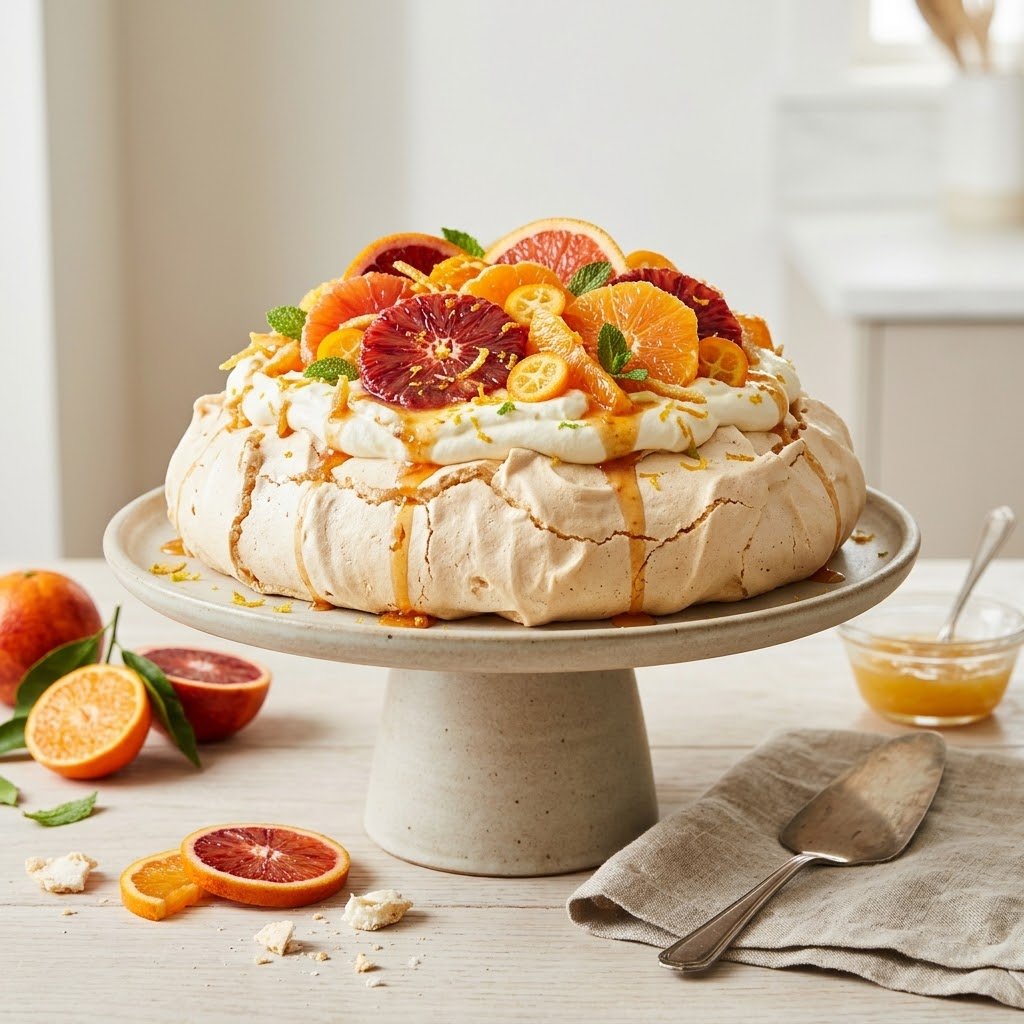
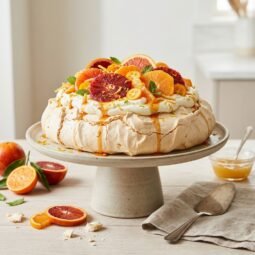
The result is a crisp, pale shell with a soft marshmallow center, topped with lightly sweetened cream, ribbons of curd and a pile of blood oranges, oranges and clementines. This winter citrus pavlova serves 8 and is easiest when you split the work: bake the shell and cook the curd the day before, then assemble it shortly before dessert.
How This Citrus Pavlova Recipe Comes Together
This citrus pavlova recipe has four parts, but only the meringue needs your full attention. Use this plan to spread them out.
| Part | Hands-on time | When to make it |
|---|---|---|
| Meringue shell | 20 minutes, plus 90 minutes baking and 3 hours cooling | Up to 2 days ahead |
| Lemon curd | 15 minutes, plus 2 hours chilling | Up to 5 days ahead |
| Citrus | 15 minutes | Up to 1 day ahead |
| Whipped cream and assembly | 10 minutes | Within 1 hour of serving |
Ingredients and What Each One Does
Everything for this citrus pavlova recipe is listed below, and the same amounts appear in the printable card at the end of the post.
For the meringue shell
- 5 large egg whites (about 150 g): separate the eggs while cold, when the yolks are firmer, then let the whites come to room temperature. Keep the yolks for the curd.
- 1¼ cups (250 g) superfine sugar: the fine crystals dissolve faster, which helps prevent a weeping meringue. To make your own, pulse granulated sugar in a food processor for about 30 seconds.
- 2 teaspoons cornstarch and 1 teaspoon white vinegar: these give pavlova its soft, marshmallow middle instead of the dry crunch of a plain meringue.
- 1 teaspoon vanilla extract and a pinch of fine salt: both round out the sweetness.
For the lemon curd
- 5 large egg yolks: the ones you saved from the shell.
- ½ cup (100 g) granulated sugar and a pinch of salt.
- ⅓ cup (80 ml) fresh lemon juice and 1 teaspoon finely grated zest: about 2 lemons. Fresh juice matters here because the curd has so few ingredients.
- 4 tablespoons (56 g) cold unsalted butter, cubed: stirred in at the end for a silky finish.
For the topping
- 1½ cups (360 ml) cold heavy whipping cream, 2 tablespoons powdered sugar and 1 teaspoon vanilla extract.
- 2 blood oranges, 1 navel or Cara Cara orange and 2 clementines: see the citrus guide below for swaps.
- Small mint leaves: for a little green against all that orange.
Step 1: Bake the Pavlova Shell
Heat the oven to 250°F (120°C) with a rack in the lower third. If your oven runs on convection only, use 225°F (105°C). Draw an 8-inch (20 cm) circle on a sheet of parchment, flip the paper so the ink faces down, and set it on a rimmed baking sheet.
- Start with a clean bowl. Wipe the bowl and whisk with a paper towel dampened with a little vinegar. Any trace of fat or yolk will stop the whites from foaming properly.
- Whip to soft peaks. Beat the whites and salt on medium speed for about 3 minutes, until the peaks hold their shape but flop over at the tip.
- Add the sugar slowly. With the mixer running, add it 1 tablespoon at a time, waiting 15 to 20 seconds between additions. Rushing this step is the most common reason a pavlova leaks syrup later.
- Do the finger test. Keep beating until the meringue is thick and glossy and holds a stiff peak. Rub a little between your thumb and finger. If it feels gritty, beat for another minute and test again.
- Fold in the rest. Sprinkle the cornstarch, vinegar and vanilla over the top and fold gently with a spatula until no streaks remain.
- Shape it low and wide. Pile the meringue inside the circle, keeping it 2 to 3 inches tall, and press a shallow well into the center with the back of a spoon. That well will hold the cream and curd.
- Bake, then leave it alone. Bake for 80 to 90 minutes, until the outside feels dry and the base lifts cleanly from the parchment. Turn off the oven and let the pavlova cool inside with the door closed for at least 3 hours, or overnight.
Step 2: Turn the Leftover Yolks Into Lemon Curd
Whisk the yolks, sugar, lemon juice, zest and salt together in a small, heavy saucepan. Cook over medium-low heat, stirring constantly and scraping the corners, for 6 to 8 minutes. The curd is ready when it coats a spatula and reaches 170°F (77°C) on an instant-read thermometer, which is safely above the 160°F recommended for egg mixtures. Keep it below a boil, or the yolks can scramble.
Take the pan off the heat and stir in the butter a few pieces at a time. Strain the curd into a bowl, press plastic wrap directly onto the surface and chill for at least 2 hours. It thickens as it cools and makes about 1 cup, which is the right amount for this lemon curd pavlova. A pavlova with lemon curd works best when the curd is fully chilled, so it sits on the cream instead of sinking in. If you use store-bought curd instead, our guide to recipes with egg yolks has ideas for the spare yolks.
Step 3: Choose and Cut the Citrus
Aim for at least three kinds of fruit so you get a mix of color, sweetness and tartness. These all work well:
| Citrus | What it adds | How to cut it |
|---|---|---|
| Blood orange | Deep red color, tart berry notes | Peel, then slice into ¼-inch rounds |
| Navel orange | Mild sweetness, no seeds | Peel, then slice into rounds |
| Cara Cara orange | Pink flesh, low acidity | Peel, then slice into rounds |
| Clementine | Floral sweetness | Very thin wheels or peeled segments |
| Meyer lemon | Fragrant, gentler than a regular lemon | Paper-thin wheels, used sparingly |
| Grapefruit | Bold, bitter-tart edge | Segments with the membranes removed |
| Kumquat | Sweet skin, sour flesh | Thin coins with the seeds removed |
Use a sharp knife to cut away the peel and the bitter white pith. If you like the look of a few wheels with the peel on, keep them thin and place them on top where they are easy to set aside. Then spread the slices on a double layer of paper towels for 15 minutes and blot the tops. Wet fruit is the fastest way to soften the shell. Any juice left on the board can go into a glass of our blood orange juice.
Step 4: Assemble Close to Serving Time
- Peel the parchment away and set the shell on a serving plate. A few cracks are normal, and the topping will cover most of them.
- Whip the cream, powdered sugar and vanilla to soft peaks. Stop while the cream still looks smooth and billowy.
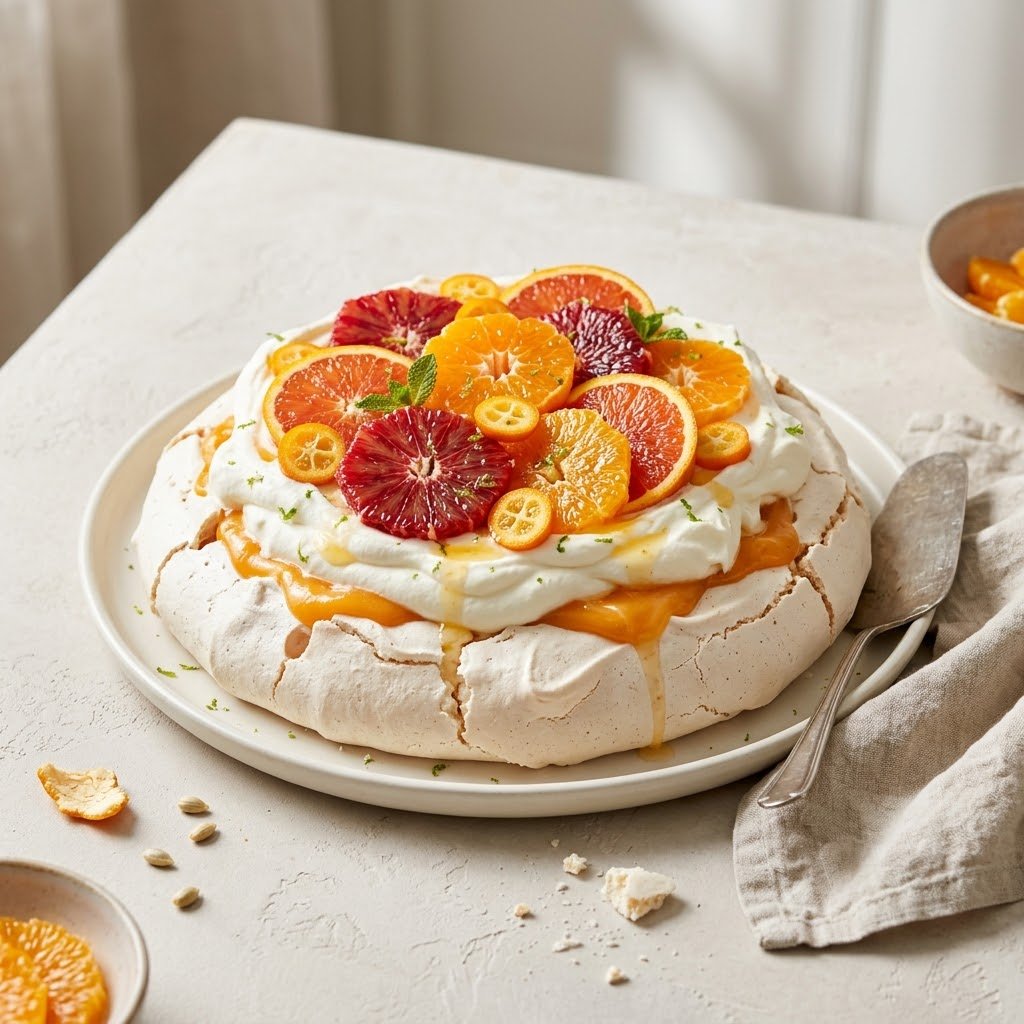
- Spoon the cream into the well. Dollop on half of the curd and swirl it with two or three strokes of a knife.
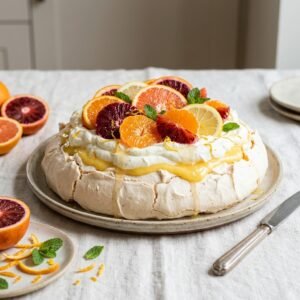
- Arrange the citrus on top, overlapping the slices. Spoon over the remaining curd, letting a little run down the sides, and finish with mint.
- Serve within an hour. A serrated knife and a gentle sawing motion give the neatest slices.
Want a richer topping that holds its shape a little longer? Swap the plain cream for our mascarpone whipped cream.
What a Good Slice Looks Like
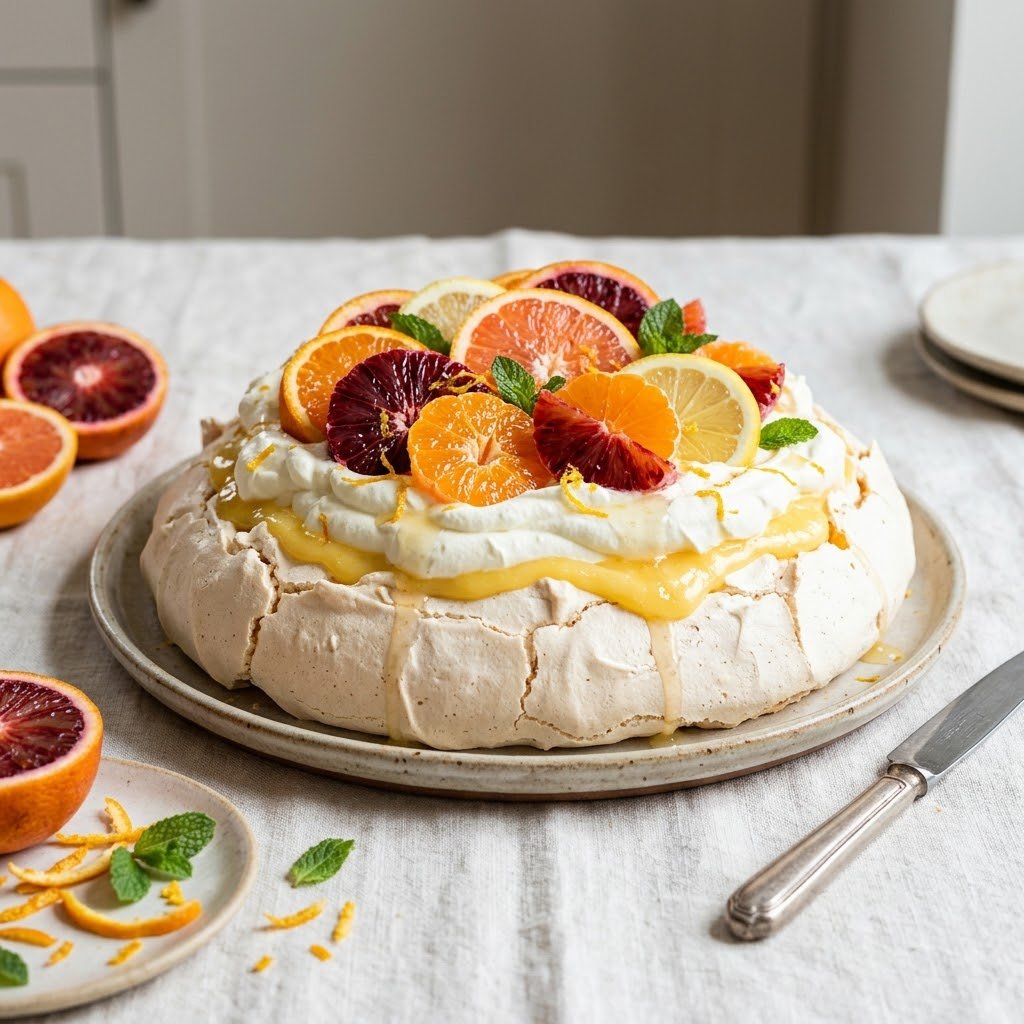
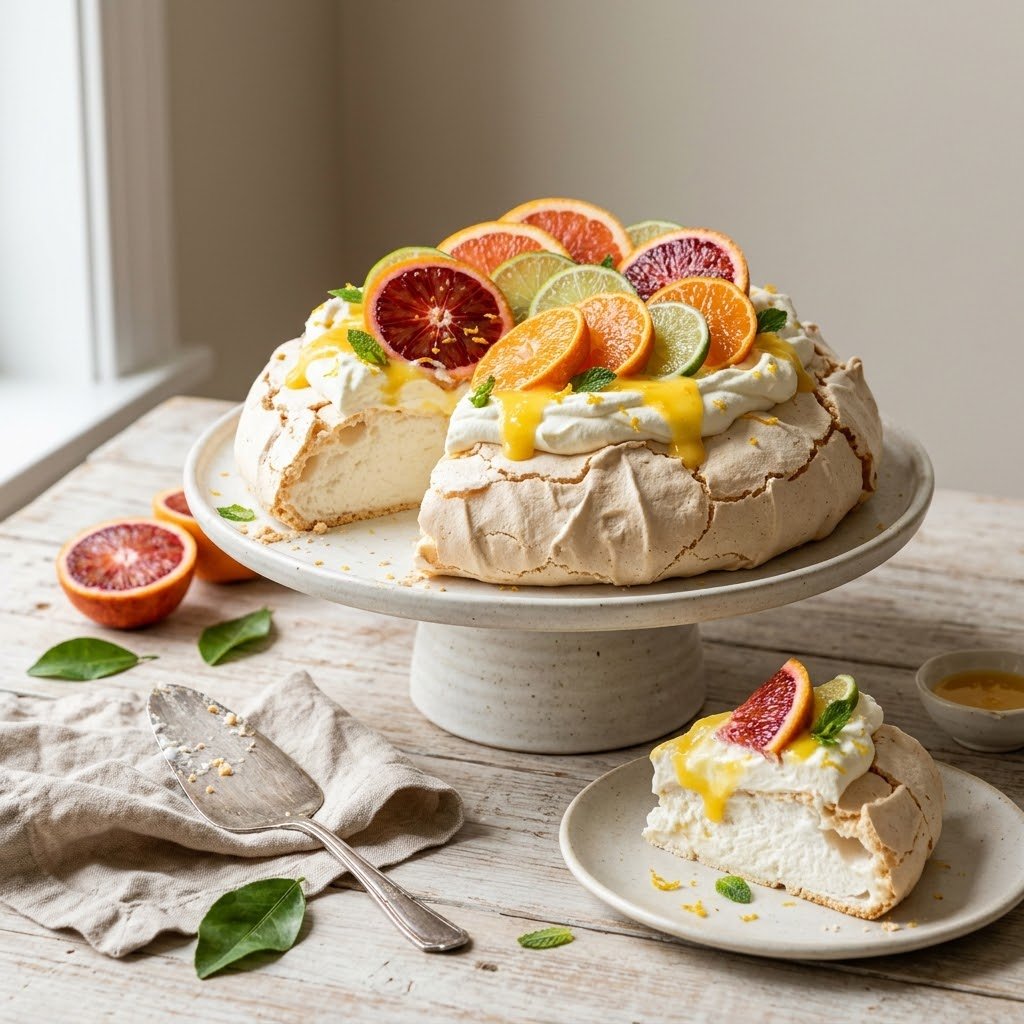
Cut into a well-baked pavlova and you should see a thin, crisp outer shell around a soft white center with the texture of marshmallow. The shell will shatter as the knife goes through it, and that is part of the charm. A slice is meant to look a little messy on the plate.
Citrus Pavlova Recipe Troubleshooting
Meringue is sensitive to sugar, heat and moisture, so most problems trace back to one of those three.
| Problem | Likely cause | Next time |
|---|---|---|
| Syrup leaking from the shell | Undissolved sugar, or meringue left sitting before baking | Add the sugar slowly, do the finger test and bake right after shaping |
| Large cracks or collapse | Oven too hot, door opened or cooling too fast | Check the oven with a thermometer and cool the shell in the closed oven |
| Sticky or soft exterior | Underbaking or a humid kitchen | Bake 10 to 15 minutes longer and store the shell airtight |
| Beige or browned shell | Oven running hot | Lower the temperature by 25°F (15°C) |
| Whites will not whip | Fat or yolk in the bowl | Start again with fresh whites and a freshly wiped bowl |
| Soggy base after topping | Wet fruit or assembling too early | Blot the citrus and assemble within an hour of serving |
Easy Variations
- Honey citrus pavlova: to give this citrus pavlova recipe a honey finish, replace ¼ cup (50 g) of the sugar in the curd with 3 tablespoons of mild honey, then drizzle a little more over the fruit just before serving. Keep the sugar in the meringue as written, since honey adds moisture the shell cannot handle. Our honey syrup makes an easy, pourable drizzle.
- Mini pavlovas: shape the meringue into 8 nests about 3 inches wide. Bake for 45 to 55 minutes, then cool in the closed oven for at least 1 hour.
- Blood orange pavlova: use only blood oranges on top and replace 2 tablespoons of the lemon juice in the curd with blood orange juice.
- Roasted citrus: toss the peeled slices with 1 tablespoon of sugar and roast at 425°F (220°C) for about 20 minutes. Cool completely and drain well before topping.
- Dairy-free: use whipped, chilled full-fat coconut cream on top and a dairy-free butter in the curd.
- Extra crunch: scatter chopped pistachios or pomegranate seeds over the fruit.
Make-Ahead and Storage
| Component | How to store it | How long |
|---|---|---|
| Unfilled shell | Airtight container at room temperature | Up to 2 days |
| Unfilled shell, frozen | Airtight container, thawed at room temperature | Up to 1 month |
| Lemon curd | Refrigerated with plastic wrap on the surface | Up to 5 days |
| Sliced citrus | Covered in the refrigerator, blotted before using | Up to 1 day |
| Assembled pavlova | Loosely covered in the refrigerator | Until the next day |
Keep the empty shell out of the refrigerator, where the damp air will soften it. Once assembled, the curd and cream make this a chilled dessert, so follow the FDA’s 2-hour limit for egg dishes and refrigerate any leftovers promptly. The shell will turn soft and chewy overnight, but it still tastes very good.
Where Pavlova Comes From
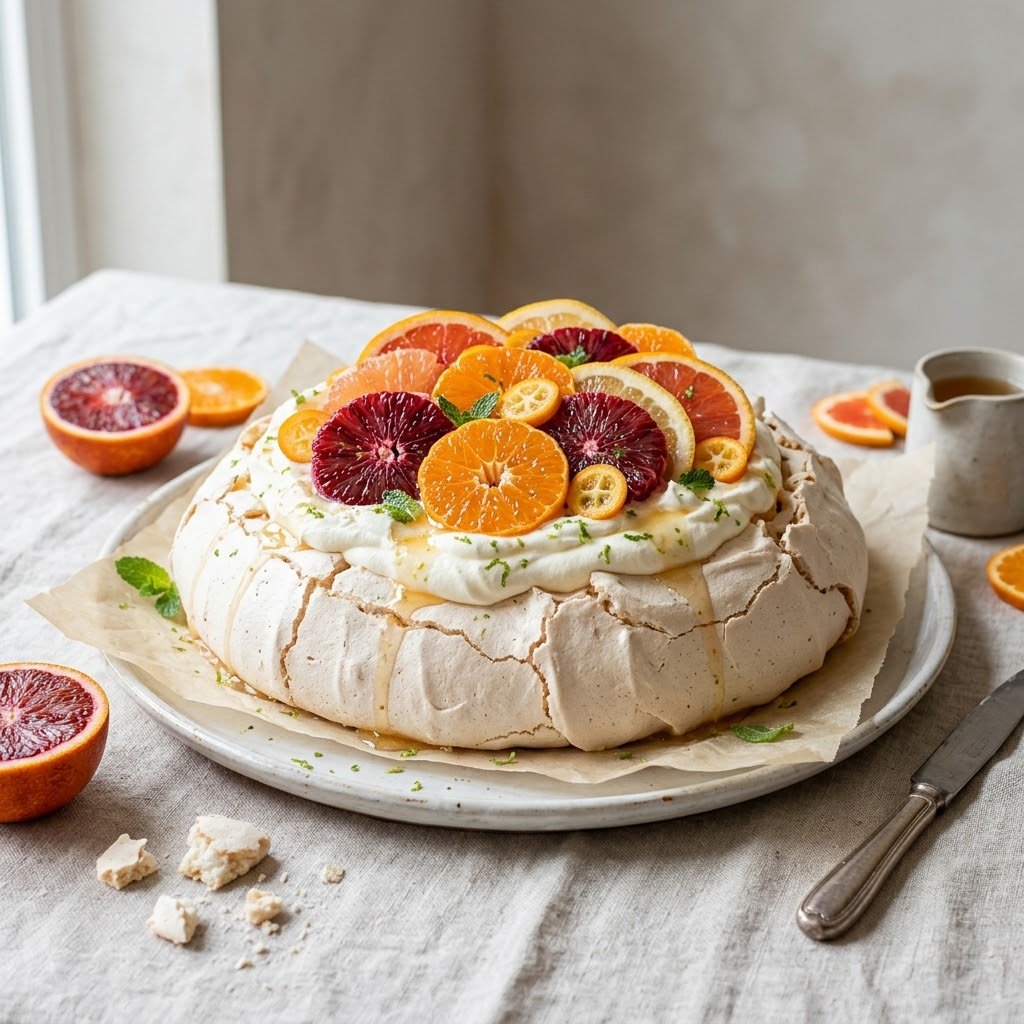
The dessert is named after the Russian ballerina Anna Pavlova, who toured Australia and New Zealand in the 1920s, and both countries have claimed it ever since. The Oxford English Dictionary traces the first recorded pavlova recipe to New Zealand in 1927, although that version was a layered jelly rather than a meringue. Researchers have since argued that its roots lie in older European and American meringue cakes, so the debate is still very much alive.
Citrus Pavlova FAQ
What is the difference between pavlova and meringue?
Pavlova is a type of meringue. Cornstarch and an acid such as vinegar keep its center soft and marshmallow-like, while a classic baked meringue dries out and turns crunchy all the way through.
Can I make citrus pavlova the day before?
Yes, as long as you keep the parts separate. Bake the shell, cook the curd and slice the fruit the day before, then whip the cream and assemble within an hour of serving.
Can I use cream of tartar instead of vinegar?
Yes. Add ½ teaspoon of cream of tartar to the egg whites once they turn foamy, and leave out the vinegar.
Can I use regular granulated sugar?
You can, but it takes longer to dissolve. Add it even more slowly and rely on the finger test, or pulse it briefly in a food processor first.
Is this pavlova gluten-free?
The recipe contains no wheat flour, but check the labels on your cornstarch and vanilla if you are serving someone who must avoid gluten. You will find more options in our gluten-free dessert recipes.
Can I bake pavlova on a humid day?
You can, but sugar pulls moisture from the air, so the shell may turn sticky sooner. Run the air conditioning or a dehumidifier if you have one, and leave the shell in the closed oven until you are ready to fill it.
Printable Citrus Pavlova Recipe
Citrus Pavlova Recipe With Lemon Curd
Equipment
- Stand mixer or hand mixer
- Rimmed baking sheet
- Parchment paper
- Small heavy saucepan
- Fine mesh strainer
- Instant-read thermometer
Ingredients
Meringue shell
- 5 large egg whites about 150 g, room temperature; save the yolks
- 1¼ cups superfine sugar 250 g
- 2 teaspoons cornstarch
- 1 teaspoon white vinegar
- 1 teaspoon vanilla extract
- 1 pinch fine salt
Lemon curd
- 5 large egg yolks
- ½ cup granulated sugar 100 g
- ⅓ cup fresh lemon juice 80 ml, from about 2 lemons
- 1 teaspoon lemon zest finely grated
- 1 pinch salt
- 4 tablespoons cold unsalted butter 56 g, cubed
Cream and citrus topping
- 1½ cups cold heavy whipping cream 360 ml
- 2 tablespoons powdered sugar
- 1 teaspoon vanilla extract
- 2 blood oranges peeled and sliced into rounds
- 1 navel or Cara Cara orange peeled and sliced into rounds
- 2 clementines thinly sliced
- small mint leaves for garnish
Instructions
Bake the shell
- Heat the oven to 250°F (120°C) with a rack in the lower third. Draw an 8-inch (20 cm) circle on parchment, flip the paper ink side down and set it on a baking sheet.
- In a spotlessly clean bowl, beat the egg whites and salt on medium speed until they hold soft peaks, about 3 minutes.
- With the mixer running, add the superfine sugar 1 tablespoon at a time, waiting 15 to 20 seconds between additions. Beat until the meringue is thick, glossy and smooth when rubbed between your fingers.
- Sprinkle the cornstarch, vinegar and vanilla over the meringue and fold gently with a spatula until no streaks remain.
- Pile the meringue inside the circle, keeping it 2 to 3 inches tall. Make a shallow well in the center with the back of a spoon.
- Bake for 80 to 90 minutes, until the outside is dry and the base lifts from the parchment. Turn off the oven and leave the pavlova inside, door closed, for at least 3 hours or overnight.
Make the lemon curd
- Whisk the egg yolks, granulated sugar, lemon juice, zest and salt in a small heavy saucepan. Cook over medium-low heat, stirring constantly, for 6 to 8 minutes, until thick enough to coat a spatula and 170°F (77°C) on a thermometer. Do not let it boil.
- Off the heat, stir in the butter a few pieces at a time. Strain into a bowl, press plastic wrap onto the surface and chill for at least 2 hours.
Assemble
- Lay the sliced citrus on a double layer of paper towels for 15 minutes and blot the tops dry.
- Whip the cream, powdered sugar and vanilla to soft peaks.
- Set the shell on a serving plate. Spoon the cream into the well, dollop on half of the curd and swirl lightly. Arrange the citrus on top, spoon over the remaining curd and scatter with mint. Serve within 1 hour, cutting with a serrated knife.

Notes
- Make ahead: keep the unfilled shell in an airtight container at room temperature for up to 2 days. Refrigerate the curd for up to 5 days.
- Leftovers: refrigerate within 2 hours and eat the next day. The shell will soften.
- Convection ovens: reduce the temperature to 225°F (105°C).
- Honey version: replace ¼ cup (50 g) of the curd sugar with 3 tablespoons mild honey. Keep the sugar in the meringue as written.
- Calories are an estimate per slice, calculated from the listed ingredients.
Looking for another showstopping dessert? Try our bombe Alaska with toasted meringue, the tangy Arizona Sunshine lemon pie or a soft honey and lemon cake.