
A good roast beef rump roast recipe has one job: turn a lean, affordable cut into thin, rosy slices that are juicy enough to eat on their own and sturdy enough for next-day sandwiches. Rump roast can do that, but it does not forgive guesswork. It has very little marbling, so a few degrees too far and it goes from tender to chewy. The method below is built around that fact: salt it early, sear it hard, roast it gently at 300°F, pull it by temperature, rest it, and slice it thin against the grain.
You will also make a quick pan gravy from the drippings and roast potatoes and carrots in the hot oven while the beef rests, so everything lands on the table at the same time. If you only want the quantities and steps, jump to the recipe card. If you want to understand why each step matters, keep reading.
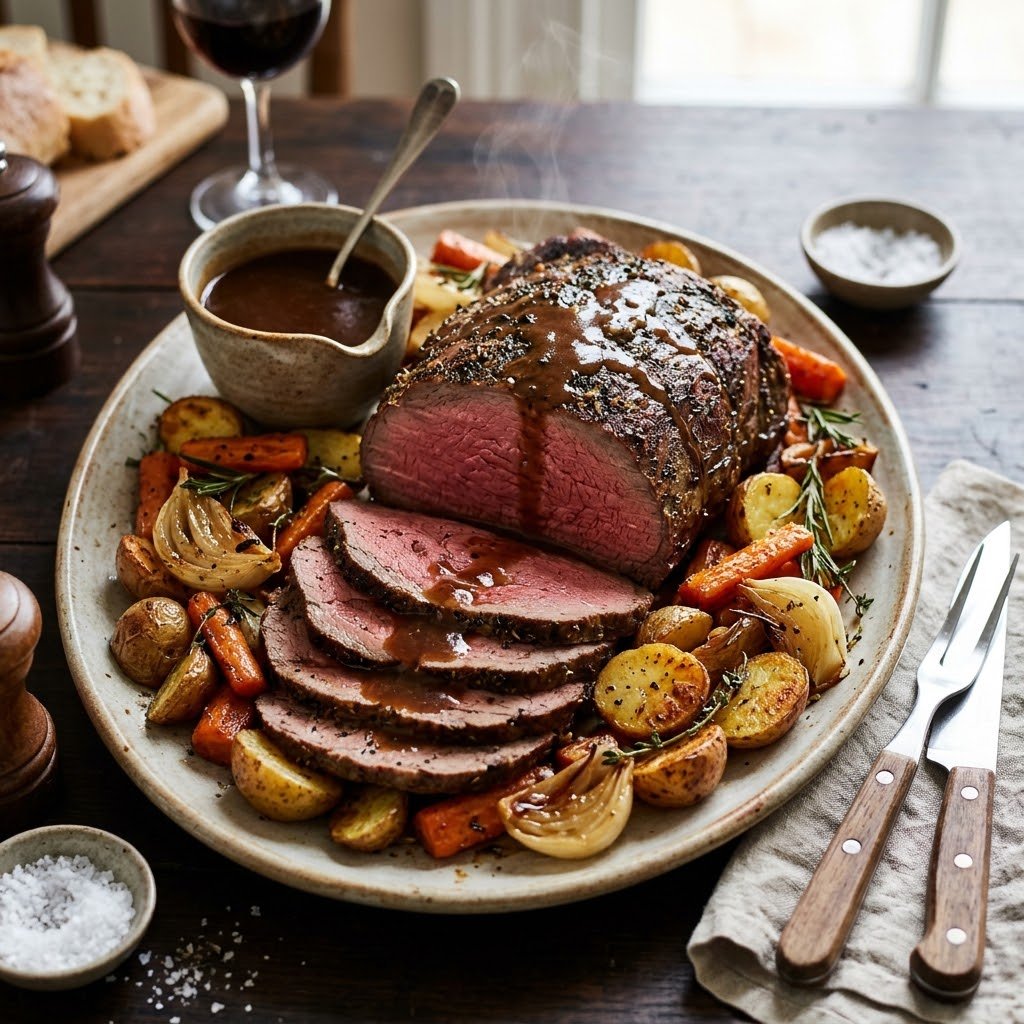
What Is a Rump Roast, Exactly?
Rump roast comes from the round primal, the hind leg of the steer, close to where the leg meets the hip. In many US grocery stores you will see it labeled as “bottom round rump roast” or simply “rump roast.” It is a working muscle, which explains both its strengths and its weaknesses. The strength is flavor: it tastes clearly beefy, more so than a tenderloin. The weakness is texture: the fibers are long and fairly tight, and there is little intramuscular fat to keep the meat moist if it overcooks.
That is why rump roast is usually treated in one of two ways. The first is low, wet heat for hours, the pot roast route, where the meat is cooked well past well-done until the connective tissue softens and it falls apart. The second is dry oven roasting to medium-rare or medium, then slicing thin. This roast beef rump roast recipe takes the second route. The result is classic deli-style roast beef: pink in the middle, browned and seasoned on the outside, and best when carved into thin slices.
If you prefer the fork-tender, shredded style, a slow-cooked cut such as our arm roast recipe or the Pikes Peak roast will suit you better. Those cuts have more connective tissue and reward long braising.
How to pick a good rump roast at the store
- Size: A 3 to 4 pound roast feeds 6 to 8 people and roasts evenly. This recipe is written for 3½ pounds.
- Shape: Look for an even, compact shape. A roast that is thick at one end and thin at the other will cook unevenly. If that is all you can find, tie it with kitchen twine.
- Color: Bright to deep red meat with no gray patches or sour smell.
- Fat cap: A thin layer of fat on one side is a bonus. Leave it on; it bastes the roast as it cooks.
- Grade: Choice grade has a little more marbling than Select and gives a juicier roast for a small price difference.
The Roast Beef Rump Roast Recipe Method at a Glance
Before you start, it helps to see the whole plan. The total hands-on time is short; most of the work is waiting.
| Stage | What you do | Time |
|---|---|---|
| Salt (dry brine) | Salt the roast and chill it uncovered | 12 to 24 hours (or 45 minutes minimum) |
| Sear | Brown all sides in a hot skillet | 10 to 12 minutes |
| Roast | Herb paste on, into a 300°F oven | About 1¼ to 1¾ hours |
| Rest | Tent with foil on a board | 20 minutes |
| Vegetables and gravy | Roast vegetables at 425°F, make gravy on the stove | During the rest, plus a few minutes |
| Carve | Slice thin against the grain | 5 minutes |
Why Each Step Matters
1. Salt it early
Salting the roast a day ahead is the single biggest upgrade you can make. At first, salt draws moisture to the surface. Given time, that salty liquid is reabsorbed and seasons the meat deeper than the outer layer. It also helps the proteins hold onto more of their own juice during cooking, which matters a lot with a lean cut. Leaving the roast uncovered in the fridge dries the surface, and a dry surface browns faster and better.
If you forget, do not skip the salt. Season it 45 minutes before searing and let it sit at room temperature. You will still get a well-seasoned crust; the interior will just be a little milder.
2. Sear first, roast low
A hot oven alone can brown a roast, but by the time the outside is dark, a thick gray band has formed under the crust. Searing in a skillet gives you the browned, savory outside in about ten minutes. Then a moderate 300°F oven brings the center up slowly, so the color from edge to center stays more even and pink. Low oven heat is the reason this roast beef rump roast recipe stays juicy without any braising liquid.
Brown every side, including the two ends. Use tongs to hold the roast upright against the pan when needed. Once seared, let it cool for a minute before spreading on the garlic and herb paste. If the paste goes onto a screaming-hot surface, the garlic can scorch and turn bitter.
3. Cook to temperature, not to the clock
Every roast is shaped differently, ovens run hot or cold, and a roast straight from the fridge cooks slower than one that sat out. Time ranges are only a guide. An instant-read or leave-in probe thermometer is the one tool this recipe really needs. Insert it horizontally into the thickest part, away from the pan.
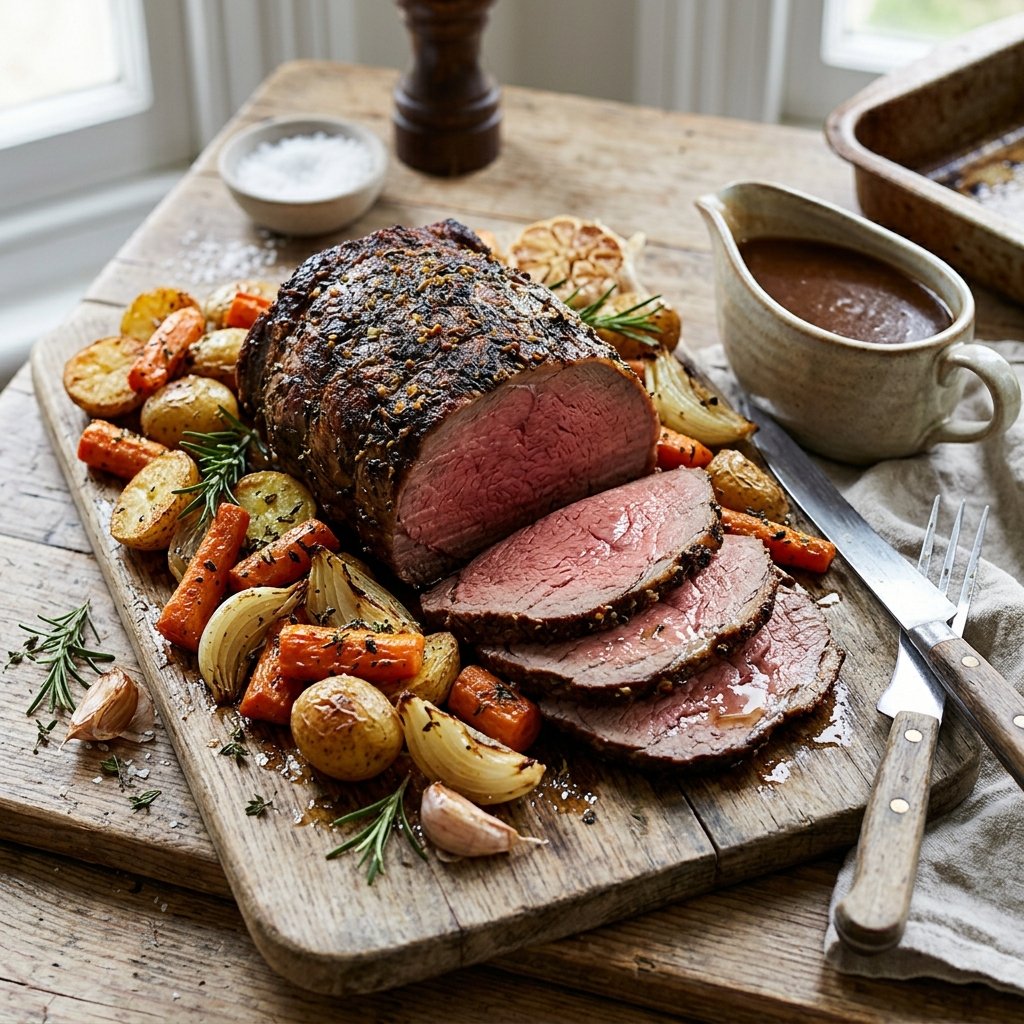
Rump Roast Temperature Chart
The roast keeps cooking after it leaves the oven. This is called carryover cooking, and for a roast this size it usually adds about 5°F during the rest. Pull it a little early so it lands where you want it.
| Doneness | Pull from oven | After resting | What it looks like |
|---|---|---|---|
| Rare | 115 to 120°F | 120 to 125°F | Deep red, very soft |
| Medium-rare | 125°F | 130 to 135°F | Rosy pink center, juicy |
| Medium | 135°F | 140 to 145°F | Light pink, firmer |
| Medium-well | 145°F | 150 to 155°F | Mostly gray, noticeably drier |
For rump roast, medium-rare to medium gives the best texture. Past medium, the lean fibers tighten and the meat gets chewy.
A note on food safety: the USDA lists 145°F followed by a three-minute rest as the safe minimum internal temperature for whole cuts of beef, including roasts. You can check the current guidance on the FoodSafety.gov temperature chart. Many cooks choose a lower temperature for roasts because the inside of an intact whole cut is not where surface bacteria live, but that is a personal choice. If you are serving young children, pregnant guests, older adults, or anyone with a weakened immune system, cook to at least 145°F. The Beef. It’s What’s For Dinner food safety page also covers handling and storage basics.
Roughly How Long to Cook a Rump Roast at 300°F
As a starting point, a seared rump roast at 300°F usually takes about 22 to 30 minutes per pound to reach 125°F. That works out to:
- 2 to 2½ pounds: about 55 to 75 minutes
- 3 to 3½ pounds: about 1¼ to 1¾ hours
- 4 to 5 pounds: about 1¾ to 2¼ hours or more
Start checking the temperature about 20 minutes before the low end of the range. A thick, round roast takes longer than a long, flat one of the same weight.
The Garlic and Herb Crust
The seasoning paste here is simple on purpose: garlic, fresh rosemary, thyme, black pepper, onion powder, a spoonful of Dijon, and olive oil. The mustard is optional, but it helps the herbs cling to the meat and adds a faint tang that you will not taste as “mustard” once the roast is done. Fresh herbs give the cleanest flavor; if you only have dried thyme, use half the amount.
Other combinations that work well with this roast beef rump roast recipe:
- Smoky: smoked paprika, garlic powder, black pepper, and a pinch of brown sugar.
- Horseradish: 2 tablespoons prepared horseradish mixed into the Dijon and garlic.
- Peppercorn: coarsely cracked black, green, and pink peppercorns pressed into the surface before searing.
- Coffee rub: finely ground coffee, chili powder, and garlic, which gives a dark, steakhouse-style crust.
How to Carve Rump Roast So It Eats Tender
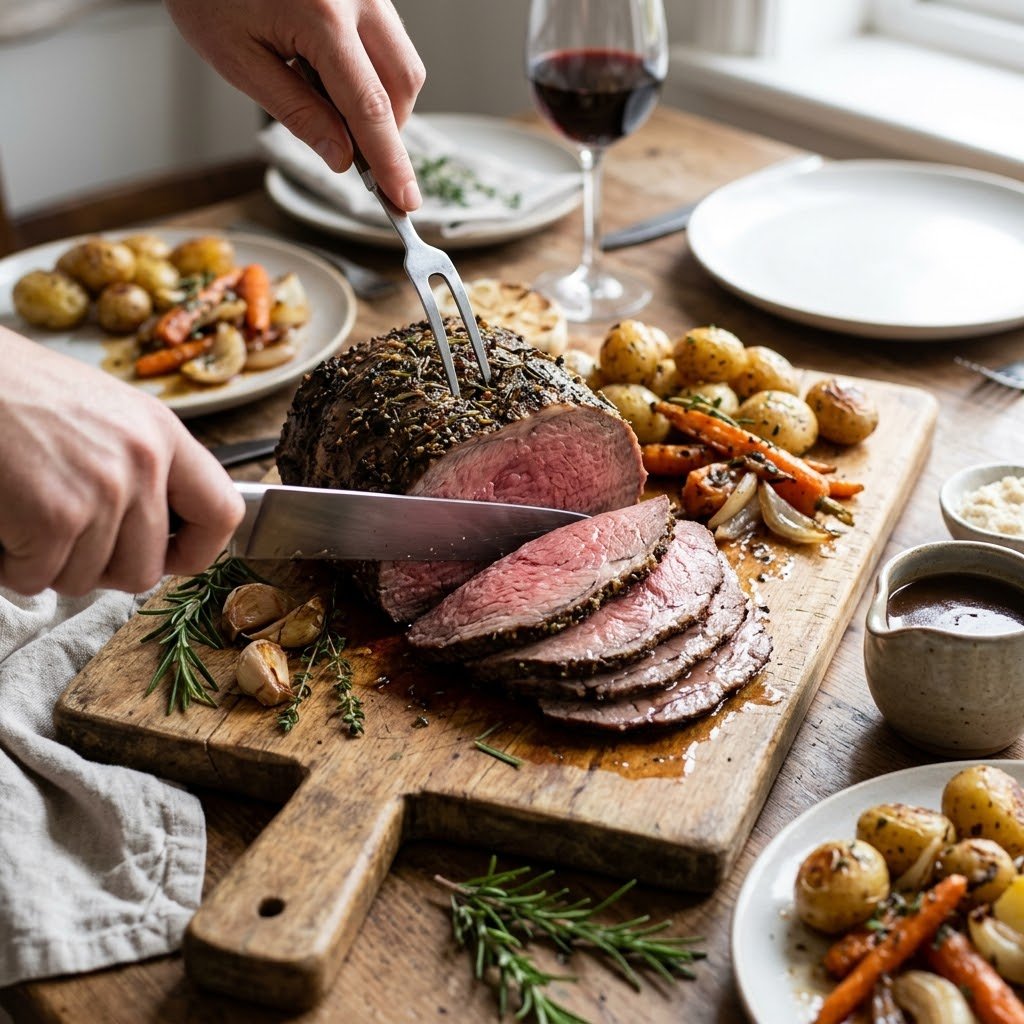
This step is as important as the cooking. Look at the surface of the roast and you will see the muscle fibers running in one direction. Turn the roast so your knife cuts across those lines, not along them. Cutting against the grain shortens the fibers in each slice, and short fibers are what your teeth read as tender.
Slice thin, about a quarter inch or less. A long, sharp carving knife makes it easier to get clean, even slices in one stroke instead of sawing. If you want deli-thin slices for sandwiches, chill the leftover roast completely first; cold meat slices much more cleanly.
Making Pan Gravy From the Drippings
A lean roast does not leave a lot of fat in the pan, which is why this gravy starts with butter. The browned bits stuck to the pan, called fond, carry most of the flavor, so do not wash the pan while the beef rests.
- Set the roasting pan or skillet over medium heat and melt the butter.
- Whisk in the flour and cook for a minute or two until it smells toasty and turns light tan.
- Pour in warm beef broth a little at a time, whisking and scraping the bottom of the pan.
- Add Worcestershire sauce and the juices that collected on the cutting board while the roast rested.
- Simmer until it coats a spoon, then taste and adjust the salt and pepper.
Use low-sodium broth. The drippings and the salted crust already add plenty of salt, and regular broth can make the gravy too salty once it reduces. If the gravy gets too thick, whisk in a splash more broth. If it is too thin, simmer a few minutes longer.
Common Rump Roast Mistakes and How to Avoid Them
- Cooking it straight from the fridge without a plan. A cold roast is fine, but expect a longer cook time and rely on the thermometer.
- Skipping the rest. Slice it right away and the juices run all over the board. Twenty minutes under loose foil keeps them in the meat.
- Roasting too hot for too long. A long stretch at 400°F or more gives a thick overcooked layer around a small pink center.
- Cutting with the grain. Even a perfectly cooked roast will feel tough if the slices are cut along the fibers.
- Overcooking “to be safe.” If you want it well-done, a braise is a better plan for this cut than oven roasting.
- Tenting too tightly. A tight foil wrap traps steam and softens the crust. Keep it loose.
What to Serve With Roast Beef
The recipe card includes roasted baby potatoes, carrots, and onion because they share the oven and soak up the gravy. Other sides that suit a rump roast dinner:
- Creamy mashed potatoes or honey gold potatoes
- Yorkshire puddings, baked in the hot oven after the roast comes out
- Green beans with garlic, or roasted Brussels sprouts
- A crisp green salad with a sharp vinaigrette to balance the rich gravy
- Horseradish cream: sour cream, prepared horseradish, lemon juice, and a pinch of salt
Leftovers, Storage, and Reheating
Leftovers might be the best part of making a roast beef rump roast recipe. Cool the beef within two hours of cooking, then refrigerate it in an airtight container for three to four days. Keep the gravy in a separate container.
To reheat without overcooking, warm the gravy in a skillet until it simmers, turn off the heat, and lay the sliced beef in it for a minute or two. That warms the slices through while keeping them pink. Microwaving thin slices on high tends to turn them gray and tough.
For longer storage, freeze sliced beef with a little gravy in freezer bags, flattened, for up to three months. Thaw overnight in the refrigerator.
Ideas for leftover roast beef
- Hot roast beef sandwiches smothered in gravy, like this open faced roast beef recipe
- Cold roast beef on rye with horseradish cream and pickles, or a loaded chuckwagon sandwich
- French dip with the leftover gravy thinned with broth for dipping
- Roast beef hash with diced potatoes, onions, and a fried egg on top
- Thin strips tossed into a stir-fry or a steak-style salad
Can You Make This Rump Roast in a Slow Cooker or Instant Pot?
You can cook rump roast in either, but you will get a different dish. Both methods use moist heat and are meant to take the meat well past medium, so the result is pot roast: tender, shreddable, and served in its cooking liquid, rather than pink sliced roast beef. For a slow cooker, sear the roast, add about a cup of broth plus onions and carrots, and cook on low for 8 to 9 hours until it pulls apart easily. In an electric pressure cooker, plan on roughly 60 to 70 minutes at high pressure for a 3-pound roast, followed by a natural release. Both are good meals, just not the classic sliced roast this page focuses on.
Rump Roast vs. Other Roasting Cuts
| Cut | Fat and tenderness | Best method | Price |
|---|---|---|---|
| Rump roast | Lean, moderately tender when sliced thin | Roast to medium-rare, or braise | Budget-friendly |
| Eye of round | Very lean, uniform shape | Roast to medium-rare, slice very thin | Budget-friendly |
| Sirloin tip | Lean, slightly more tender | Roast or grill | Moderate |
| Chuck roast | Well marbled, lots of connective tissue | Braise or slow cook | Budget-friendly |
| Prime rib | Rich marbling, very tender | Roast | Expensive |
If you like the idea of a chuck roast cooked fast, see our air fryer chuck roast. For something leaner than beef, the bison chuck roast is worth a look.
Roast Beef Rump Roast Recipe FAQs
Should I cover rump roast in the oven?
No. For a sliced, roast-beef-style result, roast it uncovered so the crust stays dry and browned. Covering it traps steam, which is closer to braising.
Do I need a rack?
A rack lets hot air reach the bottom so the roast cooks evenly and the underside does not steam in its juices. If you do not have one, set the roast on thick slices of onion or carrot, or roast it right in the oven-safe skillet you seared it in.
Why is my rump roast tough?
Usually one of three reasons: it was cooked past medium, it was not rested, or it was sliced with the grain. Thin slices across the grain fix a lot.
Can I cook it from frozen?
It is possible, but it takes about 50 percent longer and the outside tends to overcook before the center is ready. Thawing it in the refrigerator for one to two days gives a much better result.
How much rump roast per person?
Plan on about 6 to 8 ounces of raw meat per person, a little more if you want leftovers. A 3½-pound roast serves about 8.
Is rump roast the same as bottom round?
They are closely related. Both come from the round, and rump roast is often sold as bottom round rump roast. They cook the same way, so you can use them interchangeably in this recipe.
Final Thoughts
Rump roast will never be as forgiving as a marbled prime rib, but it does not need to be. Salt it ahead, sear it well, roast it gently, pull it at the right temperature, and slice it thin across the grain. Follow those steps and this roast beef rump roast recipe gives you a Sunday dinner with gravy and vegetables, plus enough leftovers for sandwiches all week, at a fraction of the cost of fancier cuts.
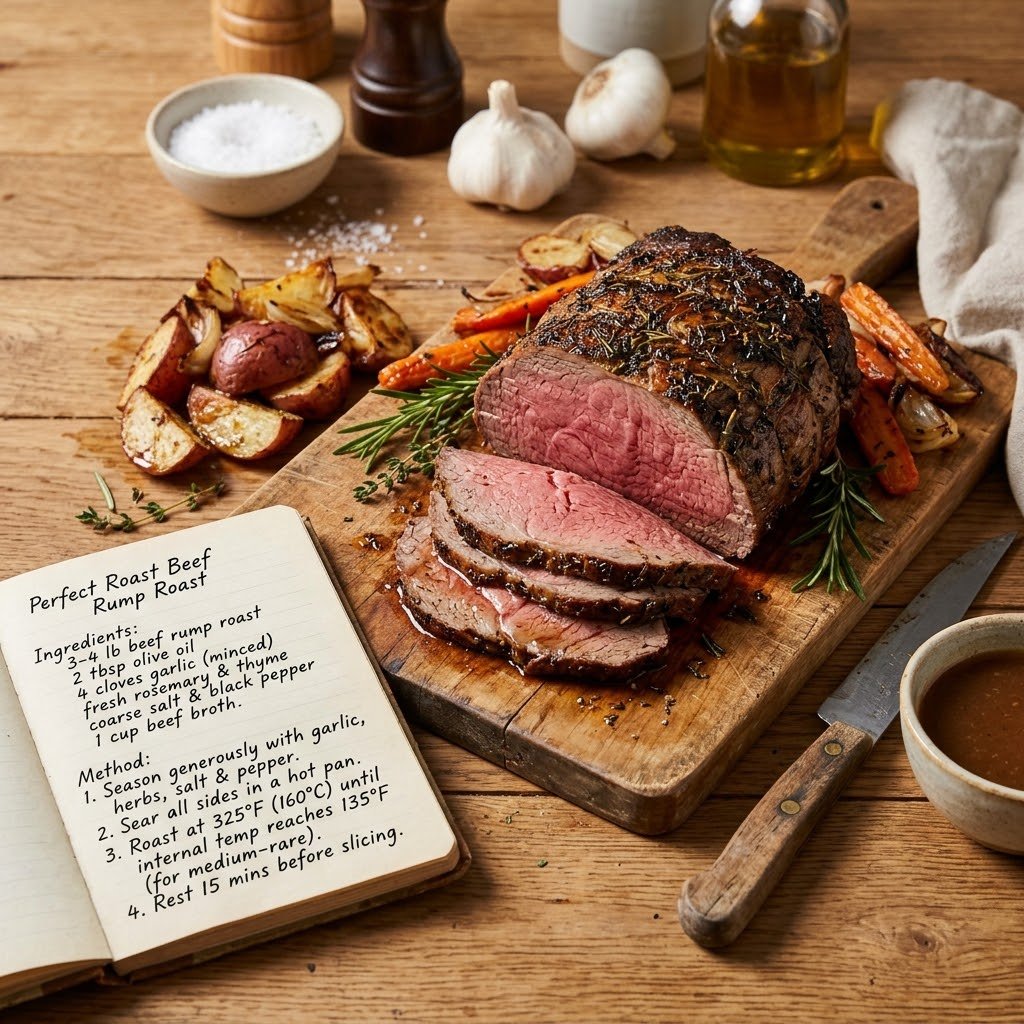
Roast Beef Rump Roast with Pan Gravy
Ingredients
Equipment
Method
- Pat the rump roast dry with paper towels. Rub it all over with the kosher salt. For the best flavor, set it on a rack over a plate and refrigerate uncovered for 12 to 24 hours; otherwise let it sit at room temperature for 45 minutes.
- Heat the oven to 300°F (150°C). Mix the garlic, rosemary, thyme, black pepper, onion powder, Dijon mustard, and 1 tablespoon olive oil into a paste. If the roast is uneven, tie it with kitchen twine every 1½ inches so it cooks evenly.
- Heat the remaining 1 tablespoon olive oil in a large oven-safe skillet over medium-high heat. Sear the roast for 2 to 3 minutes per side, including the ends, until deeply browned all over. Remove from the heat and let it cool for a minute.
- Spread the herb-garlic paste over the seared surface. Set the roast on a rack in a roasting pan (or return it to the skillet) with the fat cap, if any, facing up.
- Roast until an instant-read thermometer in the thickest part reads 125°F (52°C) for medium-rare or 135°F (57°C) for medium, about 1 hour 15 minutes to 1 hour 45 minutes for a 3½ lb roast. Start checking the temperature after 1 hour.
- While the beef roasts, toss the potatoes, carrots, and onion with 2 tablespoons olive oil, ½ teaspoon salt, and the herb sprigs on a rimmed baking sheet.
- Move the roast to a cutting board, tent loosely with foil, and let it rest for 20 minutes. The internal temperature will rise about 5°F as it rests.
- Raise the oven to 425°F (220°C) and roast the vegetables for 25 to 30 minutes, stirring once, until the potatoes are golden and the carrots are tender.
- For the gravy, set the roasting pan or skillet with the drippings over medium heat. Add the butter and, once melted, whisk in the flour. Cook for 1 to 2 minutes until lightly browned.
- Slowly whisk in the warm beef broth, scraping up the browned bits. Add the Worcestershire sauce and any juices from the resting board. Simmer for 3 to 5 minutes until thickened, then season with salt and pepper.
- Remove any twine. Slice the roast thinly, about ¼ inch thick, against the grain. Serve with the roasted vegetables and hot gravy.
Notes
- Thermometer first: Rump roast is lean, so the difference between tender and dry is a few degrees. Pull it at 125°F for medium-rare and let carryover heat finish it.
- Food safety: USDA guidance for whole cuts of beef is 145°F with a 3-minute rest. Lower temperatures are a personal preference.
- Slicing: Thin slices cut against the grain are what make this lean cut eat tender.
- Size changes: A 2 to 2½ lb roast usually reaches 125°F in about 55 to 75 minutes at 300°F; a 4 to 5 lb roast can take 2 hours or more. Go by temperature, not the clock.
- Storage: Refrigerate leftovers in an airtight container for 3 to 4 days. Slice cold for sandwiches, or reheat gently in gravy so the beef does not overcook.
- Freezing: Freeze sliced beef with a little gravy for up to 3 months. Thaw overnight in the fridge.