Go Back
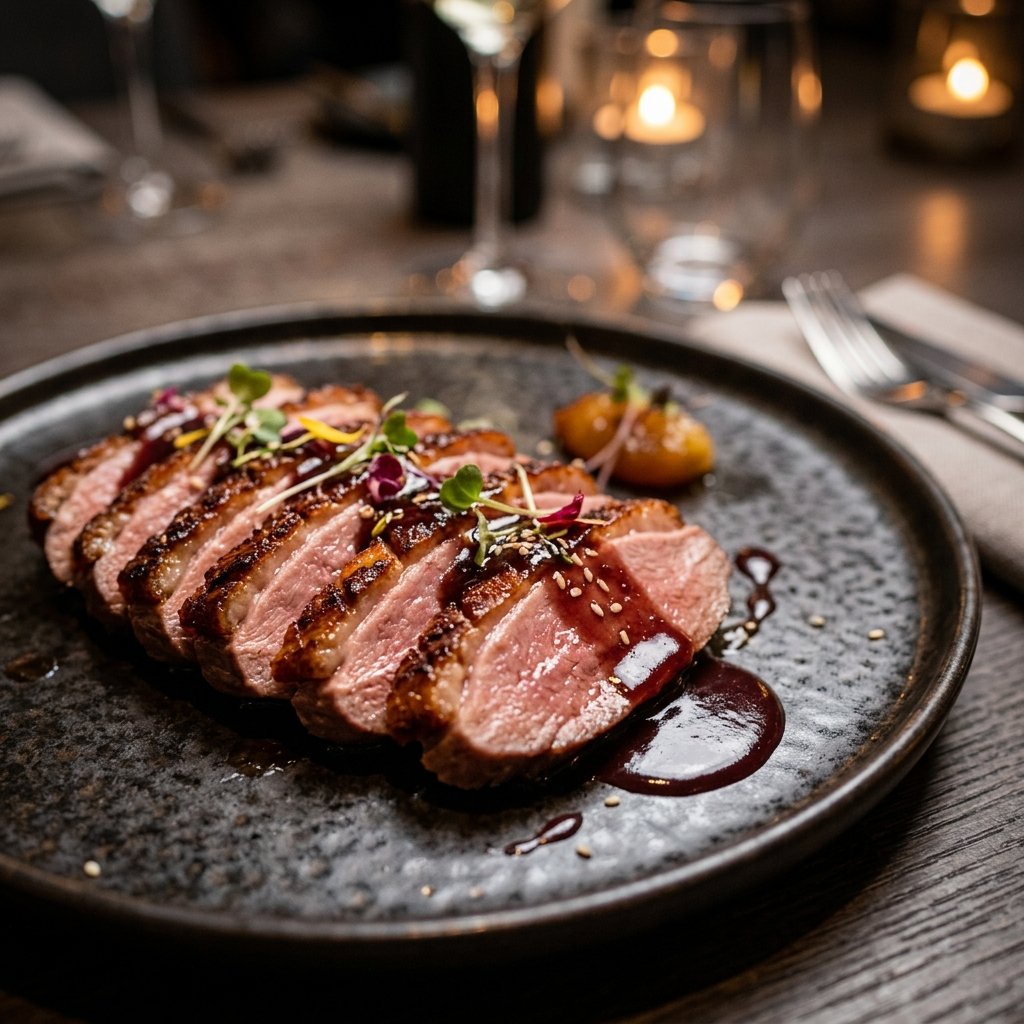
Sliced roast duck breast
Mary Johnson

Crispy Roast Duck (Golden Skin and Juicy Meat)

A whole duck dry-brined uncovered overnight, pricked to release the fat, roasted low and then finished hot. The skin comes out crackling and the meat juicy, with a jar of duck fat left over.
Prep Time 20 minutes
Cook Time 2 hours 30 minutes
Total Time 2 hours 50 minutes
Servings: 4
Course: Main Course
Cuisine: American
Calories: 700

Ingredients
  

  • 1 whole duck 5 to 6 lb / 2.3 to 2.7 kg, thawed
  • 1 tablespoon kosher salt
  • 1 teaspoon freshly ground black pepper
  • ½ teaspoon ground cinnamon or Chinese five-spice powder optional
  • 1 orange quartered
  • 1 head garlic top trimmed
  • A few sprigs of fresh thyme
  • Optional honey-orange glaze: 2 tablespoons honey 1 tablespoon orange juice, 1 tablespoon soy sauce, and 1 teaspoon rice vinegar

Equipment

  • Roasting pan with a wire rack
  • Instant-read thermometer
  • Sharp skewer or paring knife (for pricking the skin)
  • Paper towels
  • Rimmed tray (for the overnight dry rest)
  • Large spoon or turkey baster (for removing the fat)
  • Fine-mesh sieve and a clean jar (for saving the duck fat)
  • Carving knife and board
  • Small bowl and pastry brush (if using the glaze)

Method
 

  1. The day before: remove the giblets and neck from the cavity. Trim the loose flaps of skin and any large lumps of fat around the cavity opening.
  2. Pat the duck completely dry with paper towels, inside and out.
  3. Prick the skin all over at a slight angle, especially where it is thickest on the breast, thighs, and around the legs. Do not pierce the meat. Scoring the breast skin in a diamond pattern is optional.
  4. Mix the salt, pepper, and spice. Rub the mixture over the skin and into the cavity.
  5. Set the duck breast-side up on a rack over a tray and leave it uncovered in the refrigerator for 12 to 24 hours.
  6. Roasting day: take the duck out of the refrigerator 30 to 45 minutes before roasting. Preheat the oven to 325°F (165°C) with a rack in the lower third.
  7. Put the orange quarters, garlic, and thyme in the cavity and tuck the wing tips under. Set the duck breast-side up on a rack in a roasting pan.
  8. Roast for 1 hour 30 minutes. Carefully spoon off the fat from the pan, and prick the skin again, especially around the thighs.
  9. Roast another 30 minutes, then drain the fat again.
  10. Raise the oven to 425°F (220°C). Roast for 20 to 30 minutes until the skin is deep golden and crisp. If using the glaze, brush it on only during the last 8 to 10 minutes.
  11. Check that the thickest part of the thigh reads at least 165°F (74°C). Start checking after about 2 hours of total roasting time.
  12. Rest the duck on a cutting board, loosely tented, for 15 to 20 minutes. Do not wrap it tightly in foil.
  13. Carve off the legs, remove each breast whole, and slice crosswise. Serve right away.
Notes

  • Thaw a frozen duck fully in the refrigerator, which usually takes 2 to 3 days for 5 to 6 pounds. Never thaw it at room temperature.
  • Cook to at least 165°F (74°C) in the thickest part of the thigh. Duck is classed as poultry.
  • The skin must be dry. Do not skip the overnight uncovered rest. If you are short on time, a few hours helps, and pouring boiling water over the pricked duck and patting it dry can help too.
  • Prick only the skin and fat, never the meat, or the juices will escape.
  • Save the duck fat: strain it through a fine-mesh sieve into a clean jar, cool it, and refrigerate. It keeps for weeks and is excellent for roasting potatoes.
  • Honey scorches quickly, so brush the glaze on only in the last 8 to 10 minutes.
  • Do not wrap the rested duck tightly in foil, which steams and softens the skin.
  • Bread stuffing is hard to bring to a safe 165°F inside the cavity without overcooking the duck, so cook it separately.
  • Refrigerate leftovers within 2 hours and eat within 3 to 4 days. Reheat on a rack, skin-side up, in a 400°F oven for 10 to 15 minutes until hot (165°F) and crisp. Avoid the microwave.
  • A 5 to 6 pound duck feeds about 4 people.
  • Times, quantities, and nutrition are estimates. Test the recipe once and adjust to your oven.